



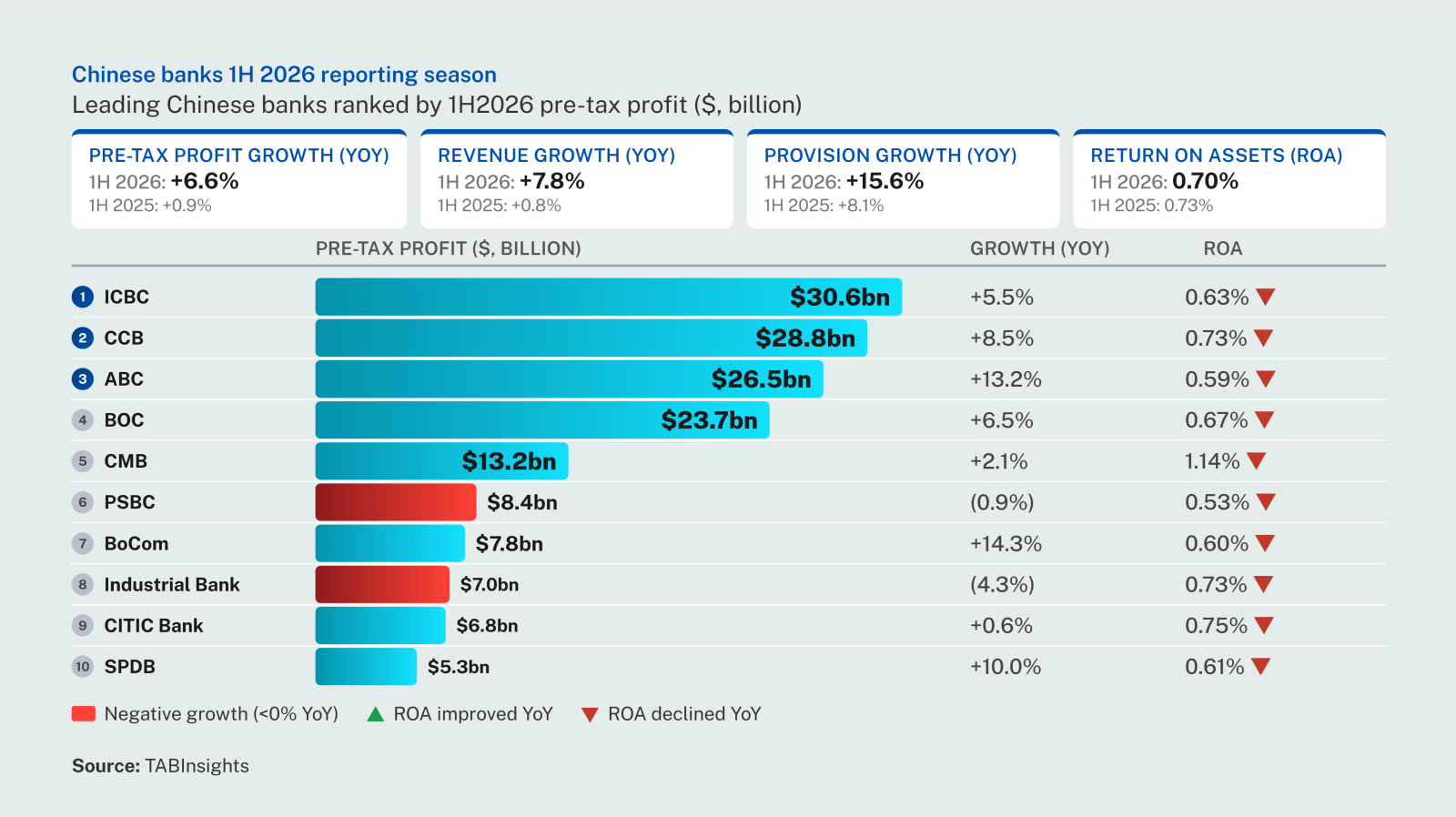

Chinese banks delivered stronger earnings growth in 1H2026, but stronger earnings were not enough to lift returns on assets and equity. Lower funding costs and stronger other non-interest income provided important support, while weaker loan demand, continued pressure on asset yields and higher credit costs limited the extent to which stronger earnings translated into improved profitability.
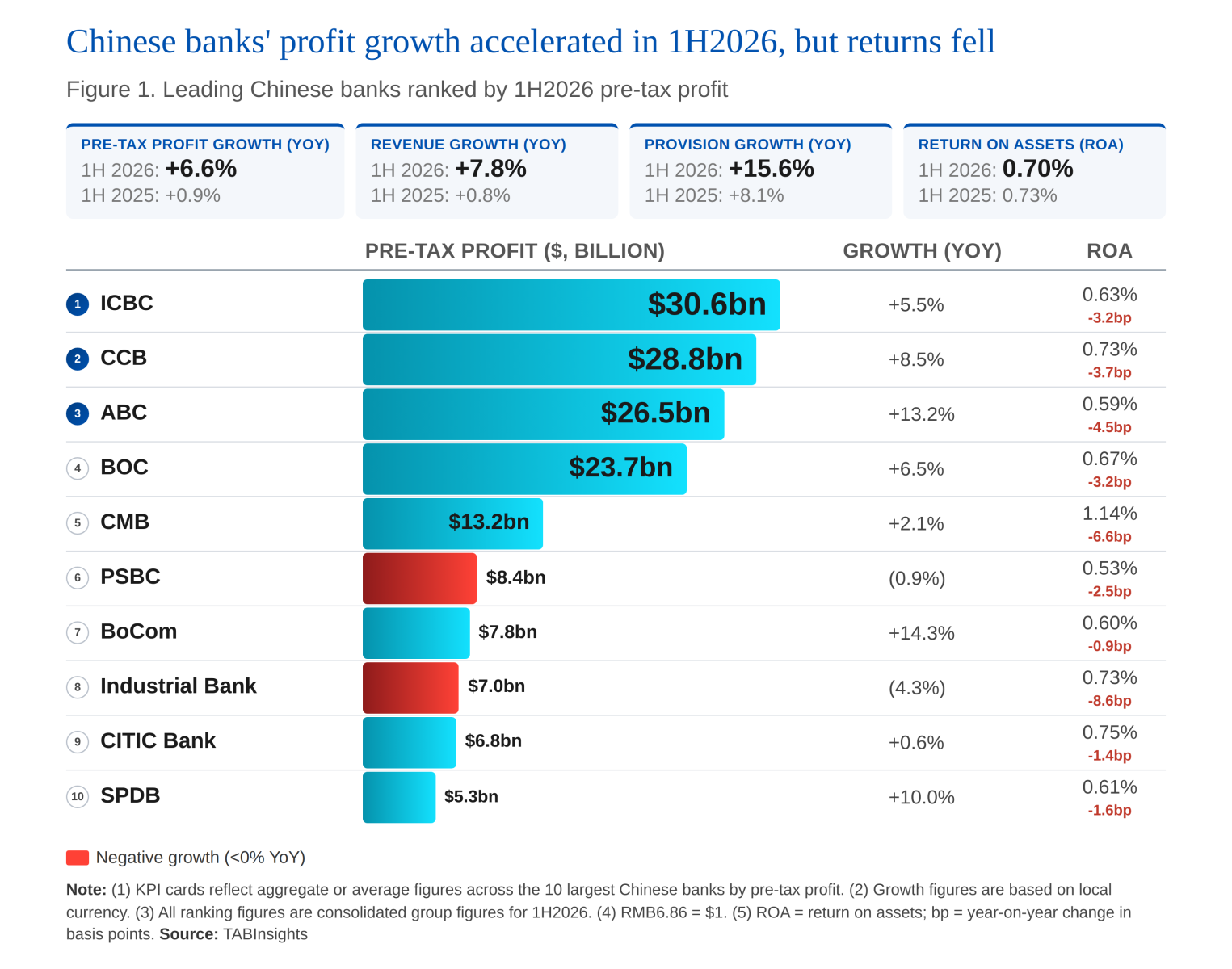
Among the 10 banks with the highest pre-tax profits in 1H2026, revenue increased 7.8% year-on-year (YoY) to RMB 2.4 trillion ($355 billion), compared with just 0.8% growth a year earlier. Pre-tax profit rose 6.6%, against 0.9% in 1H2025. Yet the simple average return on assets (ROA) fell to 0.70% from 0.73% a year earlier, while average return on equity (ROE) declined to 8.7% from 9.1%. All 10 banks recorded lower ROA, while nine reported lower ROE, with Agricultural Bank of China (ABC) the only exception. Stronger earnings therefore did not translate into higher returns as banks’ asset and equity bases continued to expand.
The main support came from net interest income, which increased 8.1% after declining 2.0% a year earlier and accounted for about 72% of revenue. The improvement was driven largely by lower funding costs rather than a recovery in asset yields. Lower funding costs, driven by more disciplined liability management, offset continued pressure on loan pricing.
There are early signs that pressure on net interest margins (NIMs) is stabilising, although the improvement remains uneven. Three of the 10 banks — Bank of Communications (BOCOM), Shanghai Pudong Development Bank (SPDB) and Bank of China (BOC) — reported higher NIMs in 1H2026 than a year earlier. At the industry level, average NIM edged up to 1.41% in Q2 from 1.40% in Q1, marking its first quarterly increase since 2022.
The contribution from deposit repricing, however, is likely to diminish. Industrial and Commercial Bank of China (ICBC) President Liu Jun said the impact would gradually weaken as the stock of existing high-cost fixed-term deposits available for repricing declines. BOC Vice President Liu Chenggang said rates on newly issued yuan-denominated loans had shown signs of stabilisation, but overall asset yields remained under downward pressure amid slower and more selective credit growth. The message for the second half of 2026 (2H2026) is therefore mixed, with liability-side relief emerging while the asset side has yet to provide a comparable source of support.
Weak credit demand remains a key constraint. Customer loans grew 6.5% YoY at end-1H2026, down from 8.1% at end-1H2025. Securities holdings grew 12.4%, also slower than the 17.4% growth recorded at end-1H2025, but still nearly twice as fast as customer loans. The shift suggests that weaker credit demand, rather than a lack of lending capacity, is influencing the composition of balance-sheet growth, with banks allocating more towards securities as loan growth slows.
Non-interest income provided another cushion, but the underlying mix was uneven. Total non-interest income increased 7.1%, slower than the 9.1% growth a year earlier. Net fee and commission income rose only 0.8%, compared with 3.6% growth in 1H2025.
The aggregate figure masks significant differences between banks. ABC reported an 8.7% decline in net fee and commission income, largely reflecting a high base from one-off gains related to existing wealth management products a year earlier. On a comparable basis, fee income grew, driven by custody and other fiduciary services, as well as settlement and clearing. Postal Savings Bank of China (PSBC), meanwhile, increased net fee and commission income by 12.2%, with wealth management remaining an important area of its retail strategy.
Other non-interest income was more supportive, increasing 14.9% and accounting for 94% of the increase in total non-interest income. Stronger investment-related income at some large banks, alongside gains from bond investments, offset subdued fee growth. ABC was a particularly strong example, with other non-interest income increasing 46.2%. But this source of income remains uneven and sensitive to market conditions, making it less dependable as a substitute for recurring fee income.
Credit costs are becoming a more significant drag on earnings. Customer loan impairment losses rose 15.6%, accelerating from 8.1% growth in 1H2025, and were equivalent to about 35% of net interest income, up from 32.8% a year earlier. PSBC’s impairment expense increased 63.8%, while SPDB recorded a 29.9% increase.
The increase partly reflects more conservative risk recognition. Several banks tightened the classification of restructured retail and credit-card loans, moving some exposures into higher-risk categories and requiring additional provisions. This does not necessarily point to a broad deterioration in asset quality, but it is putting greater pressure on current-period earnings.
Industrial Bank provides a useful counterexample to the benefits of lower funding costs. Its pre-tax profit fell 4.3%, while ROA declined nine basis points, the largest fall in the peer group. Management said the bank was still working through a deposit-repricing cycle, with further repricing of high-cost, long-term deposits expected in 2H2026. It also adopted more conservative risk classifications for some credit-card customers with negotiated instalment arrangements.
By contrast, Bank of Communications (BOCOM) provides a clear example of a more balanced approach. Pre-tax profit increased 14.3%, the fastest growth among the 10 banks, while ROA declined only 0.9 basis points, the smallest fall in the group. BOCOM Vice President Zhou Wanfu said the bank had moved away from scale-led growth, instead balancing loan and deposit volumes, pricing and risk. The share of higher-quality interest-earning assets continued to increase, while the bank reduced higher-cost deposits and less efficient interbank and bond funding.
Cost discipline provided an additional buffer. Operating expenses rose 2.4%, well below the 7.8% increase in revenue, and nine of the 10 banks improved their cost-to-income ratios.
The 1H2026 results suggest that stronger earnings alone are not enough to lift returns. Lower funding costs, stronger other non-interest income and cost discipline supported profit growth, but weaker loan growth, pressure on asset yields and rising credit costs limited the improvement in profitability. The result is stronger earnings without a corresponding improvement in returns.
For 2H2026, the challenge is to broaden earnings growth as the benefit from deposit repricing diminishes. This will require stronger credit demand and asset yields, alongside more sustainable non-interest income and continued control of credit costs. Until these conditions improve, stronger profit growth is unlikely to translate into a meaningful improvement in ROA and ROE.







.png)
.webp)







 Google
  LinkedIn