



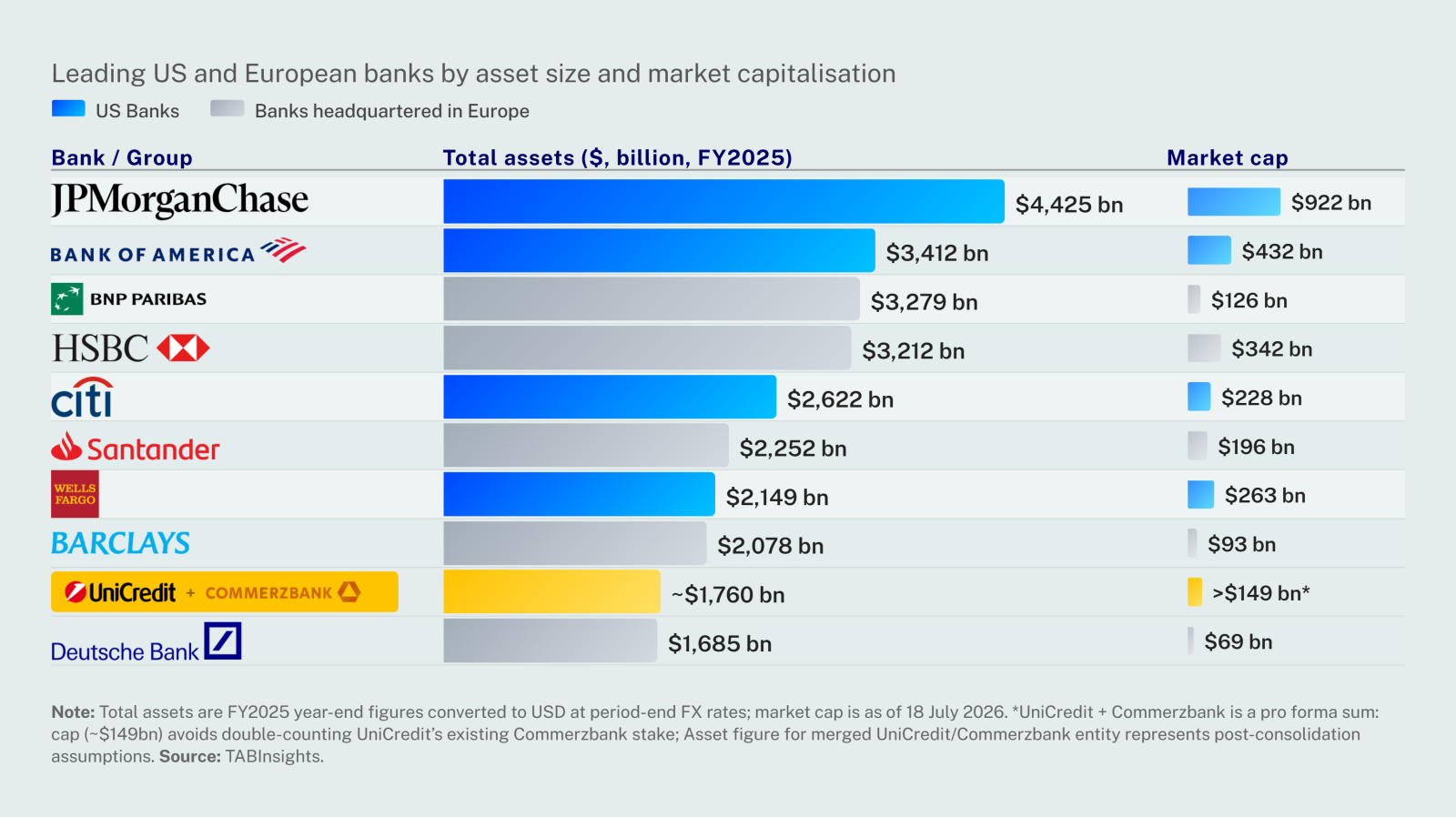

Having secured nearly 50% of the voting rights in Commerzbank, UniCredit has gained effective economic control, although it has yet to cross the formal 50% ownership threshold required for legal control. A de facto takeover is now on the horizon for 2026 or 2027, signalling a shift from nationally protected banking markets towards a more integrated, shareholder-driven European banking industry where scale, efficiency and cross-border reach increasingly outweigh political considerations.
Based on UniCredit’s second quarter 2026 earnings call, CEO Andrea Orcel expects regulatory approval as early as the fourth quarter of 2026 and intends to take the necessary steps to assume control shortly afterwards. UniCredit also plans to rationalise Commerzbank’s international network and balance sheet. The bank expects the "Commerzbank Unlocked" transformation programme to begin on 1 January 2027, either with the agreement of the German government, workforce representatives and Commerzbank’s governing bodies or, if necessary, through an extraordinary general meeting to establish control.
However, Orcel expects Commerzbank and UniCredit’s German subsidiary, HVB, to operate separately for around two to three years while their cultures, technology, operating models and commercial platforms are aligned. UniCredit plans to invest EUR 2.2 billion ($2.51 billion) in the transformation, add EUR 500 million ($570 million) in loan-loss coverage and generate EUR 1.2 billion ($1.37 billion) in pre-merger value by 2030 through procurement, product-factory integration, technology, trade-finance consolidation, near-shoring and balance-sheet optimisation. While Orcel was decisive about taking control, he remained deliberately cautious about the timing and mechanics of a legal merger.
UniCredit intends to preserve its relationships with German corporates and the Mittelstand while integrating Commerzbank into its trade-finance, trading and product platforms. As Orcel stated, “UniCredit has absolutely no intention to create any disruption to the German corporates that we're trying to serve, quite the opposite", arguing that clients stand to benefit from its more advanced trade-finance capabilities.
Germany’s Chancellor Friedrich Merz has previously criticised, albeit indirectly, UniCredit’s approach to acquiring Commerzbank. More recently, however, he has also acknowledged, again indirectly, that ownership in a market economy is ultimately determined by shareholders. Despite common European Central Bank (ECB) supervision and the single currency, Europe’s banking market remains largely organised along national lines. Geopolitical headwinds have, however, given fresh strategic urgency to deeper banking integration. As a result, the political climate may be becoming more receptive to building a genuinely integrated European financial system capable of competing with major regional banking sectors such as the US on equal terms, where capital can move freely across borders, consolidate at scale and finance Europe’s infrastructure and digital transformation through a single, deep and liquid market. Against this backdrop, Berlin’s stance appears to be shifting towards conditional acceptance of a UniCredit takeover.
A successful takeover would establish that political resistance alone is no longer enough to prevent an EU-based bank from acquiring a strategically important lender in another member state. The transaction has become a critical test of whether Europe can build banks with the scale to compete with larger US institutions. More importantly, it would demonstrate that national banking champions are no longer untouchable.
Combining UniCredit’s operations in Italy and Germany with Commerzbank and its existing German subsidiary, HypoVereinsbank (HVB), would create a significantly larger cross-border European banking franchise. While HVB has deep roots in Bavaria with strengths in private and wealth management and a focus on mid- to large-sized businesses, Commerzbank has a strong presence across central Germany, serving the mass-market retail and small- to mid-sized business segments. According to UniCredit, the combined group would become the leading trade-finance bank for small and mid-sized businesses, serving more than 35 million clients through 600 branches and accounting for around 8% of Germany’s corporate loan market.
Europe recognises the need for larger banks to compete globally, yet national governments remain reluctant to relinquish control of strategically important institutions. The ECB has identified limited cross-border integration and consolidation, driven by regulatory, governance and political barriers, as a key obstacle to realising the full benefits of the Single Market.
Commerzbank has delivered one of European banking’s most significant turnarounds in recent years, driven by four years of restructuring, revenue diversification and capital returns. Yet it remains less profitable and less cost-efficient than many of its peers. In 2025, Commerzbank reported a cost-to-income ratio of 57% and a return on equity of 8.7%, compared with 39% and 19.2%, respectively, for UniCredit Group. Its experience illustrates that stronger financial performance alone may not be enough to preserve independence as Europe pushes towards larger, more competitive banking groups. Domestic banks will face growing pressure to demonstrate compelling standalone value or risk becoming acquisition targets.
UniCredit’s ambitions for Commerzbank’s international network
Acquiring Commerzbank would also bring mBank, one of Poland’s leading digital banks, into UniCredit’s network, strengthening the combined group’s presence in one of Europe’s fastest-growing banking markets and expanding its reach across Central and Eastern Europe. UniCredit believes mBank’s profitable franchise and favourable customer demographics can be further enhanced through its product factories and pan-European network, deepening financial flows between Poland, Germany, Italy and the wider Central and Eastern European region.
UniCredit’s trade-finance business is roughly twice the size of Commerzbank’s. In 2025, it generated EUR 11.6 billion ($13.23 billion) in corporate banking revenue, accounting for 47% of group revenue, compared with EUR 4.9 billion ($5.59 billion) and 40%, respectively, for Commerzbank. Despite weaker group profitability, Commerzbank’s corporate banking division delivered a robust 17% operating return on equity.
UniCredit has criticised Commerzbank’s international network for being oversized, fragmented and operationally complex. It cites 24% loan growth outside Germany and Poland in 2025 despite flat trade-finance and cash-management fee income, arguing that capital and operating resources have been deployed to international expansion without generating commensurate returns. UniCredit plans to streamline non-core operations and refocus the network on supporting financial flows to and from Germany and Poland. It also argues that Commerzbank’s international loan growth has been driven primarily by international and financial intermediary lending rather than trade finance.
Should UniCredit gain full control of Commerzbank, it plans to centralise trade-finance engines and trading platforms, potentially relocating some roles to Germany, while scaling back lending in overseas markets and to clients outside the combined group’s core European expertise. Orcel identified selected treasury assets and lending exposures in the US and Latin America, including real estate and data centre financing, as businesses that could be disposed of relatively quickly. More broadly, the strategy would reshape Commerzbank into a more focused European banking franchise centred on supporting German, Polish and other European corporate clients. If successful, it would underscore a broader shift in European banking, where cross-border scale, operational efficiency and regional integration increasingly take precedence over maintaining expansive global lending networks.
Subscribe for regular insights.






.png)
.webp)







 Google
  LinkedIn